

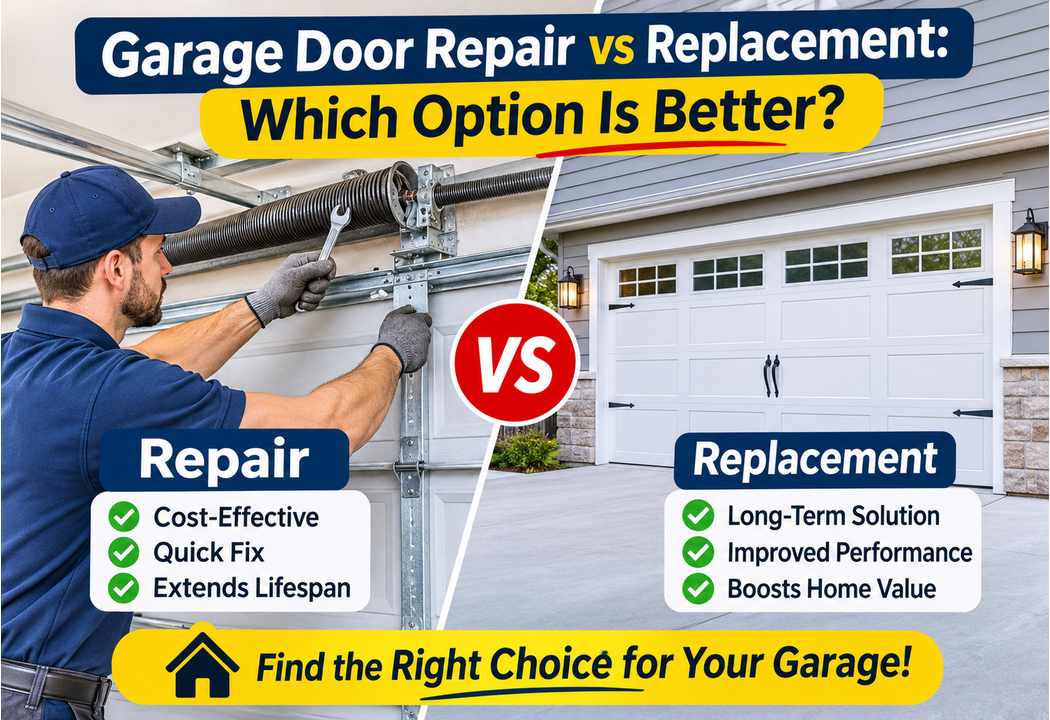
Your garage door opens and closes dozens of times a month, so when it starts to groan, shake, or refuse to move, it is easy to feel stuck between two choices: fix it or start over. The right answer depends on the door’s age, the type of damage, how often it has broken before, and what you plan to do with your home.
If you want a second opinion, our team offers professional garage door repair services across Chicago and nearby suburbs, and we will tell you honestly whether a repair is worth the money. This guide gives you the same decision framework we use on site.
The Short Answer
Repair your garage door when one part has failed (a spring, cable, roller, sensor, or opener), the door is under roughly 15 years old, and the panels and tracks are still straight and solid.
Replace your garage door when the door is 15 to 20+ years old, the panels are warped, rusted, or cracked, you keep paying for repeat repairs, or the door lacks modern safety features and insulation.
A useful rule of thumb: if a repair quote reaches about half the cost of a new door, replacement is usually the smarter long-term spend. This is a rule of thumb, not a law, so use it as a starting point.
Garage Door Repair vs Replacement at a Glance
| Factor | Repair | Replacement |
|---|---|---|
| Best for | One failed part on a sound door | Old, damaged, or unsafe doors |
| Typical door age | Under about 15 years | 15 to 20+ years |
| Upfront cost | Lower (national averages run roughly $150 to $400) | Higher (roughly $1,200 to $6,000+ depending on size, material, and insulation) |
| Time on site | Often a few hours | Usually a half day to a full day |
| Energy efficiency | No change | Can improve with an insulated door |
| Curb appeal and resale | No change | Noticeable improvement |
| Long-term reliability | Depends on remaining wear | New parts, new warranty |
Cost figures are national ranges from consumer cost guides such as HomeAdvisor and Angi. Local prices vary with door size, parts, and the complexity of the job, so request a quote for your exact situation.
When Repair Is the Better Choice
Most garage door breakdowns come from a single worn component. If the door itself is straight, quiet when balanced, and structurally sound, fixing the failed part is almost always cheaper and faster than replacing everything.
Common problems that are usually worth repairing:
- Broken torsion or extension springs. Springs wear out after a set number of cycles, so a snapped spring on an otherwise healthy door is a classic repair. See our garage door spring repair service for what the job involves.
- Frayed or snapped cables. A damaged cable can leave the door crooked or stuck. A technician can replace the cable, check the drums, and reset the tension through our garage door cable repair service.
- Opener, remote, or sensor trouble. If the motor hums but the door does not move, or the door reverses for no reason, the cause is often a sensor, remote, or logic board. Our garage door openers page covers repair and replacement options.
- Worn rollers, hinges, or weatherstripping. These are inexpensive wear parts that can make a noisy, shaky door run like new.
- Off-track doors. If the door slipped off the track but the panels are not bent, realigning it is often a straightforward fix.
- A single damaged panel. On many door models, one dented section can be replaced without replacing the whole door, as long as a matching panel is available.
When Replacement Is the Better Choice
Sometimes repairs only delay the inevitable. Consider replacement when you notice several of these signs together.
1. The door is 15 to 20+ years old. Even well-kept doors wear out. Older doors may also have outdated hardware, discontinued parts, and little or no insulation.
2. The panels are warped, rusted, cracked, or sagging. Structural damage weakens the door and its security. A new spring will not fix a bent or rotted door.
3. You are calling for repairs again and again. If you have paid for two or three repairs in a year, the money you are spending may be heading toward the price of a new door anyway.
4. The door or opener lacks modern safety features. Photo-eye sensors and auto-reverse protection exist to prevent entrapment injuries. If your system is old and cannot be updated, replacement is worth serious thought.
5. Your garage is cold, loud, or drafty. An uninsulated steel or wood door lets winter air in and can make an attached garage uncomfortable. A modern insulated door improves temperature control and reduces noise.
6. You want a better look or more value. If the door dominates your home’s front view and looks dated, a new door can change how the whole house looks.
When you are ready to compare styles and materials, our garage door installation team can measure your opening and walk you through the options.
The 50% Rule, With Real-World Examples
To make the math simple, compare the repair quote to the price of a comparable new door. If the repair costs more than about half of the replacement, lean toward replacing, especially on an older door.
| Situation | Likely Decision | Why |
|---|---|---|
| Snapped spring on an 8-year-old door in good shape | Repair | Single worn part, healthy door |
| Frayed cable on a 10-year-old door | Repair | Low-cost fix, door still sound |
| Dented lower panel on a newer door | Repair or panel replacement | Depends on whether the panel is available |
| Third repair in a year on a 22-year-old door | Replace | Repeat failures on an aging system |
| Warped, rusting panels and a drafty garage | Replace | Structural damage, poor insulation |
| Opener works but door is badly damaged | Replace door, keep opener if compatible | Opener may be reused if it is in good condition |
Does a New Garage Door Pay Off?
For homeowners thinking about selling, the numbers are encouraging. The 2025 Cost vs. Value Report from Zonda and Remodeling magazine ranked garage door replacement at the top of its list, with an average project cost of about $4,672 and an estimated resale value of roughly $12,500, a return of around 268%.
Two caveats are worth knowing. First, those figures describe a mid-range replacement project in national averages, and a basic replacement can cost much less. Second, resale value estimates are not guaranteed for any single home. Treat the report as a sign that buyers notice garage doors, not as a promise of profit.
Chicago-Specific Factors to Consider
Garage doors in the Chicago area work through freezing winters, heavy road salt, and big temperature swings. These conditions tend to affect which choice makes sense:
- Salt and moisture can corrode bottom panels, hinges, and weatherstripping, which may push an older steel door toward replacement.
- Cold weather puts extra stress on springs, cables, and opener motors, so aging parts often fail on the coldest mornings.
- Insulation matters more when your garage is attached to the house or sits beneath a room, because a better door can help keep that space more comfortable.
- Seasonal timing is practical to think about. Fixing a failing system before a deep freeze is usually less stressful than facing an emergency breakdown in January.
Why You Should Not Fix Springs and Cables Yourself
Garage door springs and cables hold the full weight of the door under very high tension. A slipped tool or a mistake with a torsion spring can cause serious injury. Even if you are handy, this is one repair that is best left to trained technicians with the right tools.
You can safely do simple maintenance such as lubricating moving parts, checking the weatherstripping, and testing the auto-reverse feature on your opener. Anything involving springs, cables, or heavy panels should go to a professional.
What a Professional Inspection Should Include
A good technician should do more than quote the cheapest fix. Expect them to:
- Check the door’s balance and look for spring wear.
- Inspect cables, drums, rollers, hinges, and tracks.
- Test the opener, sensors, and auto-reverse safety.
- Look at the panels for dents, rust, warping, or cracks.
- Explain the repair and replacement options in plain language, along with the cost of each.
If someone pushes a full replacement without showing you a real problem, get a second opinion. The same goes in the other direction: if a technician keeps patching a failing door, ask how many more repairs they expect it to need.
Quick Decision Checklist
Answer these questions honestly:
- Is the door younger than about 15 years?
- Is the damage limited to one part, such as a spring, cable, or sensor?
- Are the panels straight, solid, and free of heavy rust?
- Is the repair cost well under half the price of a new door?
- Have you had fewer than two repairs in the past year?
If you answered yes to most of these, repair is probably the better choice. If you answered no to several, ask for a replacement quote and compare.
Frequently Asked Questions
How long does a garage door last?
Many garage doors last roughly 15 to 30 years, depending on the material, how often the door is used, the climate, and how well it has been maintained. The springs usually wear out much sooner than the door itself.
Is it cheaper to repair or replace a garage door?
Repair is cheaper in the short term. Replacement can make more financial sense when an old door needs repeated or expensive repairs, or when you want better insulation, safety, and appearance.
Can I replace just one garage door panel?
Often yes, if a matching panel is still available and the rest of the door is in good condition. On older or discontinued models, matching panels can be hard to find.
Do I need a new opener if I replace the door?
Not always. A working opener in good condition and compatible with the new door can often stay. If the opener is old, noisy, or lacks modern safety features, replacing both at the same time is often smart.
Should I repair a garage door before selling my home?
If the problem is minor, a quick repair is usually enough. If the door looks worn, damaged, or outdated, replacement may improve curb appeal and buyer impressions.
Can a broken spring or cable be repaired the same day?
Often, depending on technician availability, location, and parts. Call us to ask about current availability for your address.
Not Sure? Let Our Team Take a Look
Choosing between fixing and replacing does not have to be a guessing game. Magic Touch Garage Doors has more than 20 years of experience helping homeowners and businesses across Chicago and surrounding suburbs, and we will give you a straight answer based on your door’s actual condition.
Call us at +1 312-804-2634, or request a free estimate and describe the problem. You can also learn more about our team, or see how we help homeowners with residential garage door repair in Chicago.