

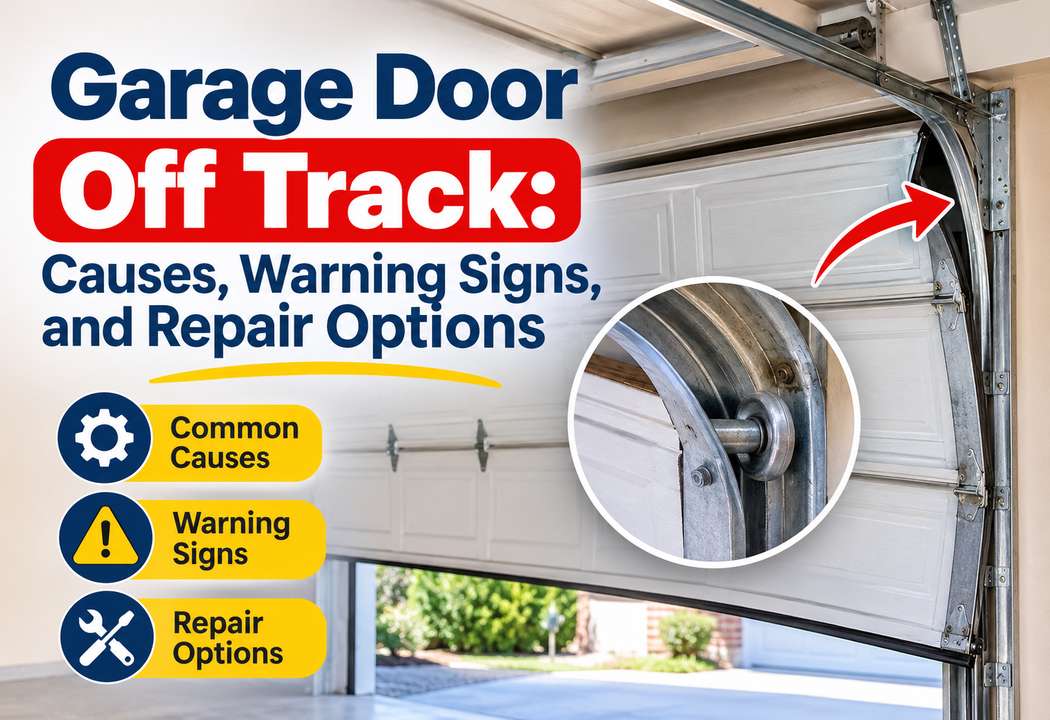
A garage door that has come off its track is one of the more serious problems a homeowner can face. The door may hang crooked, jam halfway, or refuse to move at all. A heavy door in that condition can also be unsafe to be near.
This guide explains what an off-track garage door is, what causes it, how to spot the early warning signs, and what to do (and avoid) while you wait for help.
What Does “Off Track” Mean?
Your garage door rides on rollers that sit inside metal tracks on both sides of the opening. The tracks guide the door up, over, and back down in a straight, controlled path.
A door is off track when one or more rollers pop out of the track channel. Sometimes one side drops lower than the other. Sometimes the top section of the door twists away from the rail. In the worst cases, the door buckles or hangs by a single cable.
Is an Off-Track Garage Door Dangerous?
Yes, it can be. A garage door is heavy, and the tracks, cables, and springs work together to control that weight. Once the door leaves its track, that balance is gone. The door can shift or fall without warning, and the opener can strain or damage the panels if you keep running it.
If you think your door is off track, stop using it right away.
Common Causes of a Garage Door Coming Off Track
1. Vehicle or object impact
A bumper tap while backing out, a bike, or a stored item leaning on the door can bend the track or knock a roller loose. This is one of the most common causes, especially in tight garages.
2. Bent or damaged tracks
Even a slight bend can let a roller escape. Tracks can bend from impact, from age, or from years of uneven stress.
3. Loose or misaligned track brackets
Tracks are held to the wall and ceiling by brackets. Vibration from daily use can loosen the bolts, and a track that shifts out of alignment no longer holds the rollers securely.
4. Worn, cracked, or damaged rollers
Rollers wear out over time. A cracked or flattened roller can slip out of the track far more easily than a healthy one.
5. A broken or slack cable
Cables help keep both sides of the door lifting evenly. If one snaps or loosens, one side drops and the door twists out of line. If you see a loose or frayed cable, see our guide to garage door cable repair.
6. A broken spring
Springs carry most of the door’s weight. When one breaks, the door becomes unbalanced and can jam or derail. Learn more about garage door spring repair and why it is a job for trained technicians.
7. Obstructions in the track
Debris, ice, hardened grease, or a small object in the track can block a roller and force it out of line.
8. Chicago weather
Cold winters, snow, ice, road salt, and freeze-thaw cycles can make tracks and hardware stiff or sticky. A frozen bottom seal or ice at the base of the door can also make the opener pull against resistance, which puts stress on the track.
9. Poor maintenance or past DIY adjustments
Dry hinges, worn hardware, and incorrect adjustments tend to build into larger problems over time.
Warning Signs Your Garage Door Is Off Track
Garage doors rarely derail without warning. Watch for these signs:
- The door looks crooked or sits at an angle
- One side is higher than the other
- Rollers are visible outside the track
- The door scrapes, grinds, or squeals as it moves
- The door shakes or jerks while opening or closing
- The door stops partway or will not close fully
- You can see a gap between the door and the track
- The track looks bent, kinked, or pulling away from the wall
- A cable hangs loose, or the door feels heavier than usual
- The opener runs, but the door barely moves
If you notice one or more of these, stop using the door and have it inspected before it gets worse.
What to Do If Your Garage Door Is Off Track
- Stop using the door. Do not press the remote or wall button.
- Keep people and pets away from the door and the area under it.
- Do not stand under a partially open door.
- Do not try to force the door up or down, even if it seems light.
- Take photos of the problem. They help a technician assess the issue and prepare the right parts.
- Call a professional for an inspection.
What Not to Do
- Do not push rollers back into the track yourself while the door is unbalanced.
- Do not hammer the track straight. A track that is bent usually needs to be repaired or replaced properly.
- Do not touch the springs or the cable brackets. They are under high tension and can cause serious injury.
- Do not keep running the opener. Doing so can bend panels and damage the opener.
- Do not bypass the safety sensors to force the door to close.
Garage Door Off Track Repair Options
The right fix depends on what caused the problem. A technician will inspect the whole system, not just the roller that popped out.
| Problem found | Typical repair |
|---|---|
| Roller popped out, track undamaged | Reset the door and replace worn rollers |
| Bent track section | Straighten or replace the track |
| Loose brackets | Tighten, realign, or replace brackets |
| Broken or slack cable | Replace the cable and reset tension |
| Broken spring | Replace the spring and rebalance the door |
| Damaged panels or hinges | Repair or replace affected sections |
| Severe damage or older door | Discuss replacement options |
Professional off-track garage door repair usually includes inspecting the tracks, rollers, hinges, cables, springs, and opener, then testing the door through full cycles to make sure it opens, closes, and reverses safely.
Repair or replace?
A repair makes sense when the damage is limited to the rollers, a section of track, or a cable. Replacement may be worth considering when:
- Several panels are bent or cracked
- The door has been repeatedly hit or knocked off track
- The door is old and parts are hard to match
- Repair costs start to approach the cost of a new door
What Affects the Cost of Off-Track Repair?
There is no single price, because every off-track door is different. The main factors are:
- The cause (roller, track, cable, spring, or a combination)
- How many parts are damaged
- Whether panels or hinges are bent
- The type, size, and age of the door
- Whether it is an emergency or same-day visit
The best way to get an accurate number is to describe the problem and send photos. You can request a free estimate here.
What Happens During a Technician Visit?
- Safety check. The technician secures the door and makes the area safe.
- Full inspection. Tracks, rollers, hinges, cables, springs, and opener are all checked.
- Diagnosis and options. You get an explanation of what caused the problem and what repair is recommended.
- Repair. Damaged parts are repaired or replaced and the door is realigned.
- Testing. The door is cycled several times, and the safety reverse function and opener are checked.
If your opener is also acting up, see our garage door opener services.
How to Prevent a Garage Door From Going Off Track
- Inspect your door every few months. Look for gaps, bends, loose bolts, and worn rollers.
- Keep the tracks clean. Wipe away dirt, debris, and ice. Do not over-grease the track itself.
- Lubricate moving parts such as hinges and rollers with a garage-door-safe lubricant.
- Check the balance. Disconnect the opener only when the door is fully closed, then lift it by hand gently. A balanced door should not slam shut or fly up.
- Be careful when parking. Leave enough space around the door.
- Watch for winter ice at the bottom of the door before using the opener.
- Do not ignore small noises. Grinding, squeaking, or shaking is often an early warning.
- Book yearly maintenance. A professional tune-up can catch worn parts early. Take a look at our service plans.
Need Off-Track Garage Door Help in Chicago?
Magic Touch Garage Doors has served residential and commercial customers in Chicago and nearby suburbs for more than 20 years. We also provide local service in areas such as Chicago, Skokie, Evanston, Des Plaines, Schaumburg, and Arlington Heights.
Call +1 312-804-2634 or contact us online to describe the problem and ask about availability.